Objectives
General objective
- To identify the potato variety with the greatest resistance to bacterial wilt under organic fertilization (compost and wood ash) and to evaluate the effectiveness of a biopesticide produced from banana pseudostems.
Specific objectives
- To determine the effect of the banana pseudostem biopesticide on bacterial wilt incidence and severity.
- To identify the variety combining the highest disease resistance with the best yield performance.
Methodology
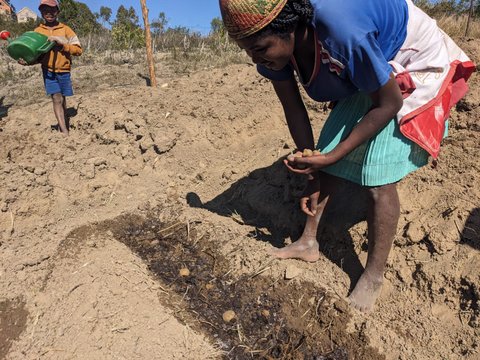
The experiment will be conducted on slightly acidic ferrallitic soil (pH ≈ 5) using three potato varieties (Maneva mena, Meva, and Bandy Akama). A Randomized Complete Block Design (RCBD) with two factors will be used: variety (three levels) and phytosanitary treatment (with or without banana pseudostem biopesticide), with three replications for a total of 18 experimental plots. All plots will receive the same organic fertilization consisting of compost and wood ash. The biopesticide will be prepared by fermenting chopped banana pseudostems for 15 days and applied as a foliar spray every two weeks on treated plots. Data will be analyzed using a two-way ANOVA followed by Fisher's LSD or Tukey's multiple comparison test.
Parameters Monitored
- Disease resistance
- Bacterial wilt incidence (%)
-
- Disease severity (%)
-
- Days to first symptom appearance
- Agronomic performance
- Emergence rate
-
- Stem height
-
- Number of stems per plant
-
- Tuber yield
-
- Average tuber size
-
- Crop cycle duration