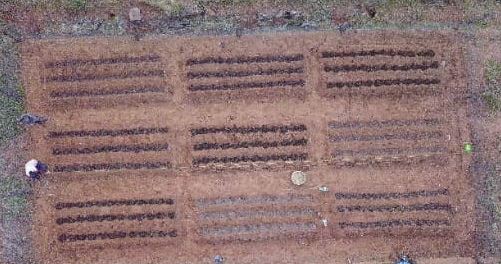
Potato (Solanum tuberosum L.) is a strategically important crop for global food security and rural economies. Its productivity depends closely on soil fertility and water availability — two factors that are frequently limiting in Madagascar's rural farming zones. Against a backdrop of growing environmental concerns and rising costs of chemical fertilizers, the use of organic amendments — cattle manure, poultry manure, and compost — represents a sustainable and affordable alternative for smallholder farmers. This study, conducted by the Minimal Irrigation Project (MIP) at Ankazondrano in the Amoron'i Mania region, aims to identify the most effective organic fertilizer under limited irrigation conditions.
Objectives
The study has two main objectives: (1) to evaluate and compare the number, average weight, and diameter of tubers per plant according to the type of organic fertilizer applied; and (2) to compare the overall hectare yield performance of three organic fertilizers — poultry manure (T1), cattle manure (T2), and compost (T3) — on potato var. bandy akama.
Methodology
The experiment was conducted in open-field conditions on a ferralitic tanety soil, amended at a rate of 20 t/ha of organic fertilizer per treatment, over a three-month growing period. The experimental design was a randomized complete block design (RCBD) with 3 replications, comprising 9 elementary plots of 1.5 × 3 m each. The three treatments compared were: T1 = Poultry manure, T2 = Cattle manure, T3 = Compost. Potato seed tubers (var. bandy akama) were planted at a spacing of 25 × 30 cm. Irrigation was maintained at a minimal rate of 10 L/m²/week throughout the growing cycle, simulating the minimal irrigation conditions characteristic of the MIP approach.
Key Results
Results showed statistically significant differences between treatments across all three measured variables: tubers per plant, tubers'weight and diameter. Poultry manure (T1) significantly outperformed the other treatments for tuber number per plant (group a), while compost and cattle manure formed group b for this variable. For average tuber weight, poultry manure and cattle manure were statistically comparable (group a), with compost significantly lower (group b). Poultry manure also achieved the highest yield per hectare overall.
Discussion and Interpretation
Discussion and Interpretation
The superiority of poultry manure is explained by its chemical composition: rich in nitrogen, phosphorus, and potassium in rapidly mineralizable forms, it releases nutrients earlier in the crop cycle, stimulating vegetative growth and tuberization in the first weeks of growth. Cattle manure shows intermediate release kinetics and remains a viable option. Compost, with its slower and more progressive decomposition, requires adequate soil moisture for microbial activity to degrade organic matter and release plant-available nutrients — a condition not fully met under the minimal irrigation rate of 10 L/m²/week used in this study.
This observation reveals a fundamental interaction between fertilizer type and irrigation regime: compost efficiency is likely underestimated in this protocol, and could perform better under higher moisture conditions. This is an important practical finding for farmer advisory work: fertilizer selection must be matched to the available irrigation system.
Under minimal irrigation conditions (10 L/m²/week), poultry manure is the most effective organic fertilizer for potato cultivation to maximize yield. Combined management of irrigation and organic fertilization is essential to optimize the performance of each amendment. These results directly inform MIP recommendations for water-efficient, productive, and sustainable smallholder agriculture.