Research was conducted between 2024 and March 2025 by MIP (also known as MAD24) on deficit irrigation in Madagascar, with the aim of improving agricultural resilience through water-efficient practices adapted to Malagasy farming realities. In a context marked by climate change, irregular rainfall, recurring droughts, and declining crop yields, the project seeks to identify irrigation practices that reduce water consumption while maintaining or improving agricultural output. Madagascar, where more than 70% of the population depends on agriculture, faces significant challenges related to soil degradation and climate variability.
These research projects are the result of a collaboration between MIP and its partners: Aqua Alimenta, FTA, and ESSA-ABC. The trials were carried out across multiple agroecological zones using a participatory approach involving student researchers and lead farmers.
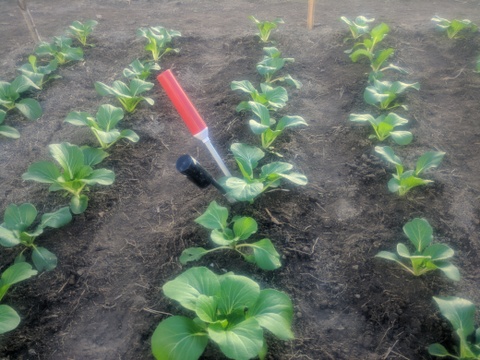
Four strategically important crops were studied: bok choy, carrot, green bean, and watermelon. For each crop, three treatments were compared: T1 (traditional farmer practices), T2 (soil moisture maintained at 55%), and T3 (soil moisture maintained at 65%), monitored using "Plant Alarm" and "Mini-Logger" soil moisture sensors. The primary objective was to determine the minimum irrigation threshold that optimizes yields while conserving water.
Four strategically important crops were studied: bok choy, carrot, green bean, and watermelon. For each crop, three treatments were compared: T1 (traditional farmer practices), T2 (soil moisture maintained at 55%), and T3 (soil moisture maintained at 65%), monitored using "Plant Alarm" and "Mini-Logger" soil moisture sensors. The primary objective was to determine the minimum irrigation threshold that optimizes yields while conserving water.
- For bok choy, results varied by study site. In Ankazondrano, T3 (65%) produced the best outcomes in terms of vegetative growth, biomass, and final yield, whereas in Ambohidray, traditional farmer practices (T1) proved more effective, likely due to the sandy soil texture and local climatic conditions. The study thus demonstrates that irrigation efficiency is strongly influenced by pedological and environmental factors.
- For carrot, T3 proved particularly effective for root yield, which is the primary production objective for this crop. Although traditional practices produced slightly greater above-ground biomass, controlled moisture at 65% promoted superior root development and higher tuberous yield. The 55% threshold was found insufficient to maximize production.
- For green bean, results were more pronounced: the 65% soil moisture treatment was the top performer, yielding the highest pod production, greater total biomass, and superior vegetative growth. Conversely, the 55% treatment induced water stress that negatively impacted productive capacity, while traditional practices provided intermediate but improvable results in terms of water use efficiency.
- For watermelon, results indicated that traditional farmer practices and T3 delivered relatively similar performance, while the 55% treatment remained less conducive to fruit development. Researchers therefore recommend maintaining soil moisture close to 65% during dry periods while preserving locally adapted practices suited to field conditions.
The research encountered several limitations, including sensor malfunctions, pest outbreaks, limited spatial replication, and insufficient integration of climatic and pedological variables. Nevertheless, research efforts are ongoing: MIP is expanding to new research sites in Ambohimanga Rova and Talatavolonondry, and is planning several projects focused primarily on irrigation management, fertilization, integrated pest management, and agroecological practices — all in pursuit of improved water resource management.