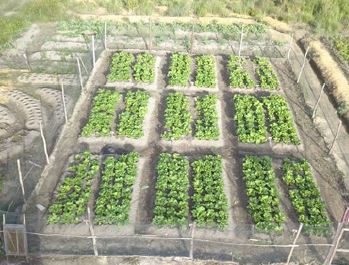
Declining soil fertility is one of the major agronomic challenges in Madagascar. While cattle manure remains the most commonly used organic amendment among Malagasy smallholders, it often proves insufficient alone to meet the production requirements of short-cycle vegetable crops, which are particularly sensitive to immediate nutrient availability. Wood charcoal residues — widely available as by-products in rural Malagasy households — represent an underutilised local resource. Although not strictly equivalent to biochar produced by controlled pyrolysis, these residues may improve certain physicochemical and biological soil properties (water retention, pH buffering, microbial activity) when incorporated as amendments. This study, conducted by MIP in the Alaotra-Mangoro region, evaluates their potential in combination with cattle manure on petsai (Brassica rapa var. chinensis), a short-cycle leafy vegetable highly dependent on initial soil fertility.
Objectives
The study has two main objectives: (1) to compare the effect of cattle manure alone, cattle manure combined with charcoal residues, and charcoal residues alone on the vegetative growth of petsai (plant height over time); and (2) to assess the impact of these three treatments on aerial biomass (harvestable parts) and root biomass per plant — direct indicators of yield and plant vigour.
Methodology
The experiment was set up as a randomized complete block design (RCBD) with 3 replications, comprising 9 elementary plots of 2 × 2.5 m (5 m² each). Spacing between planting stations was 20 cm and irrigation was set at 30 L/m²/week — substantially higher than the potato study, reflecting the greater water needs of petsai. The three treatments were: T1 = Cattle manure alone at 10 t/ha (reference treatment); T2 = Cattle manure (reduced dose) + wood charcoal residues at 5 t/ha; T3 = Wood charcoal residues alone at 5 t/ha. Data collected included plant height measured at 7 successive dates (S1 to S7) to track growth dynamics, and aerial and root biomass at end of cycle, expressed in grams per plant.
Key Results
Growth data (Figure 1 in the original poster) shows a similar progression for T1 and T2 throughout the cycle, with T3 lagging behind from the early weeks. By end of cycle (S7), T2 and T1 achieve comparable and superior heights relative to T3.
Treatment T2 (manure + charcoal residues) produced the highest aerial biomass at 916 g per plant and more voluminous roots than T3. Differences between T1 and T2 are observable but not statistically significant, indicating that both treatments are agronomically equivalent for petsai growth under these conditions.
Discussion and Interpretation
The superior or equivalent performance of treatment T2 (manure + charcoal residues) relative to manure alone (T1) can be attributed to several potentially complementary mechanisms. Even without controlled pyrolysis, charcoal residues may improve soil porosity and water retention, create favourable microhabitats for beneficial soil microorganisms, and modestly contribute to pH buffering and nutrient adsorption. Combined with manure, they form a complementary substrate: manure provides rapidly available nutrients, while the charcoal residues improve the physical properties of the root environment.
The poor performance of T3 (residues alone) confirms that wood charcoal residues, without a complementary nutrient input, are insufficient to sustain a demanding vegetable crop such as petsai. Their use in isolation is therefore not recommended. The authors also note that the initial soil characteristics (pH, texture, organic matter content) may have influenced these observations, and that additional trials on different soil types would be needed to confirm the generalisability of these findings.
The combination of cattle manure and wood charcoal residues (T2) represents the best overall compromise for petsai cultivation in terms of plant growth and biomass yield. This combination enables intelligent agroecological valorisation of locally available, low-cost residues without requiring industrial transformation processes. For farmers, adding charcoal residues to cattle manure is an accessible and relevant practice to improve vegetable productivity during the dry season. Further studies on different soil types and with varying application rates would help refine these recommendations.